

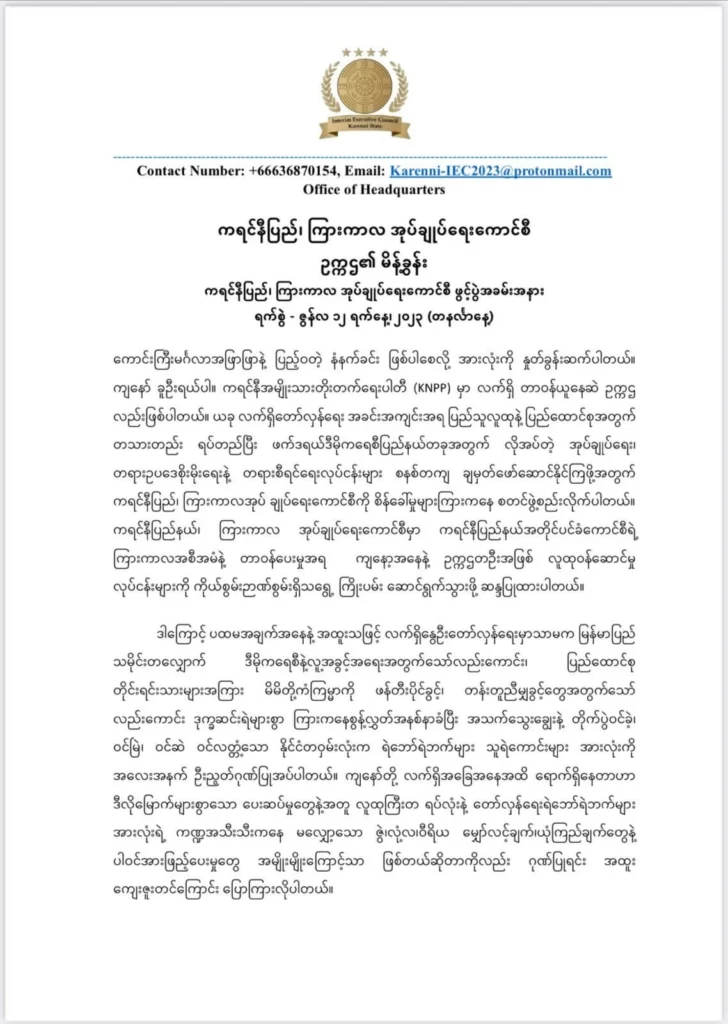
I would like to extend my greetings to everyone and wish you a morning filled with many blessings. My name is Khu Oo Reh, and I am currently serving as the Chairperson of the Karenni National Progressive Party (KNPP). In response to the current revolutionary situation, and in unity with the people and the Union, the Karenni State Interim Executive Council has been established under many challenges to systematically build and implement the administrative, rule-of-law, and judicial functions that are required for a federal democratic state.
For this Interim Executive Council of Karenni State, and in accordance with the interim arrangements and mandate of the Karenni State Consultative Council, I have expressed my commitment, as one of the Chairpersons, to carry out public service responsibilities to the best of my ability and capacity.
Therefore, first of all, I would like to pay my deepest respect to all comrades and heroes across the country who have made sacrifices and fought with their lives, blood, and sweat, in the current Spring Revolution as well as throughout Myanmar’s history, for fighting for democracy and human rights, and for the right of all ethnic nationalities within the Union to shape their own destiny and to enjoy equality, those who have fought in the past, continue to fight today, and who will keep carry on with resistance in the future. I would also like to express my heartfelt gratitude, with deep respect, in recognition that we have gained to this present situation, has been made through the countless sacrifices and the unwavering perseverance, dedication, determination, hope, and faith of the entire people and all revolutionary comrades, who have contributed and supported the struggle in many different sectors.
Secondly, I place great value on the role of young people. I recognize and believe that youth are not only the future leaders of the country, but they are also a driving force and strength. Therefore, I have encouraged and continue to encourage the new generation of young people in every positive way and as much as I can.
By the time that when young generations in countries around the world can live freely and happily, accessing to high technological skills, receiving diverse learning opportunities, innovation, and creativity, and taking leadership roles on the global stage, but, on the other hand, I recognize with pride and deep respect that our Karenni youth, along with young people across the country in Myanmar, are bravely fighting for their future and suffering in harsh forests, mountains, and ravines to bring an end to this oppressive military dictatorship. At the same time, I sincerely hope that this great revolution will not become an endpoint for their lives, and they will not lose their dreams, hopes, and aspirations.
For these reasons, this Executive Council has been initiated under the numerous challenges. On this occasion, I respectfully and sincerely appeal to our people in the State and who are abroad, as well as to our comrades, who have stood together in solidarity with the entire Karenni people, to continue providing their support and cooperation.
Thirdly, I would like to mention that, in keeping with the key milestones of our federal democratic journey, we must begin in this interim period by systematically building strong administrative structures at the state level. Only through this process can we ultimately shape a stable, resilient, and strong Federal Democratic Union.
In the historic period leading up to Burma’s independence, the Chin, Kachin, and Shan peoples signed the Panglong Agreement, which is widely known, to unite the highland regions with the Burmese central areas in forming a Union. At the same time, the Mon, Rakhine, and Karen peoples had already joined the Burmese regions earlier. They were therefore already participating in the interim central government led by General Aung San.
However, the experience of the Karenni people was different from that of other ethnic groups that joined the Union. Karenni State had a history of independent existence, and in the aftermath of World War II, the Karenni people endured severe famine and starvation experiences, which made Karenni leaders face a critical political choice: whether to join the central Burmese government, which was soon to be indepentent or to stay with the Frontier Areas Administration. Then, some leaders, without consulting with the people, made unilateral decisions and quietly signed agreements to join the Union, leading to Karenni State’s becoming part of a constituent state of Burma.
U Chan Htun, who was involved in drafting the Constitution for the Union in 1947, openly stated that although it could be called a Union on the surface, in reality, it was not a federal union that granted powers to its constituent states, but rather a unitary system. As a consequence, throughout the more than seventy years since the country gained historic independence, it has not been possible to jointly negotiate, establish, and cultivate the political principles and political practices that are necessary to genuinely implement a federal system of governance. As a result, the country has lost its way for a prolonged period of time.
As a result, ethnic nationalities have been unable to build good and secure lives in their own homelands. Instead, it goes under the domination, oppression, and prolonged conflict, countless losses have occurred, including violations of fundamental human rights, the waste of human potential, and the destruction of natural environments and resources
Under authoritarian rule, justice could not be found, and people were forced to survive under oppression. However, since 2021, it has made the world know that people across the entire country of Myanmar, regardless of ethnicity, religion, gender, or age, have united and risen collectively to resist and fight against this oppressive system.
In conclusion, although many fundamental needs remain and the struggle of the revolution has not yet been fully achieved, through the unity and collective strength of the entire people, we now have the opportunity to come together and rebuild a new history of a beautiful Federal Democratic nation.
Therefore, I encourage our brother and sister states to follow the example of Karenni State by building strong and effective administrative systems based on their current realities, even if the conditions are not yet perfect, and to work together through collective leadership to jointly build a strong Federal Democratic Union.
I would like to extend my special thanks to all representatives from across the country, as well as within the country and abroad, who have attended today’s ceremony and shown their support to us, and thank the entire public.
May God bless you all.
Download PDF file here:
⬇️ Download PDF